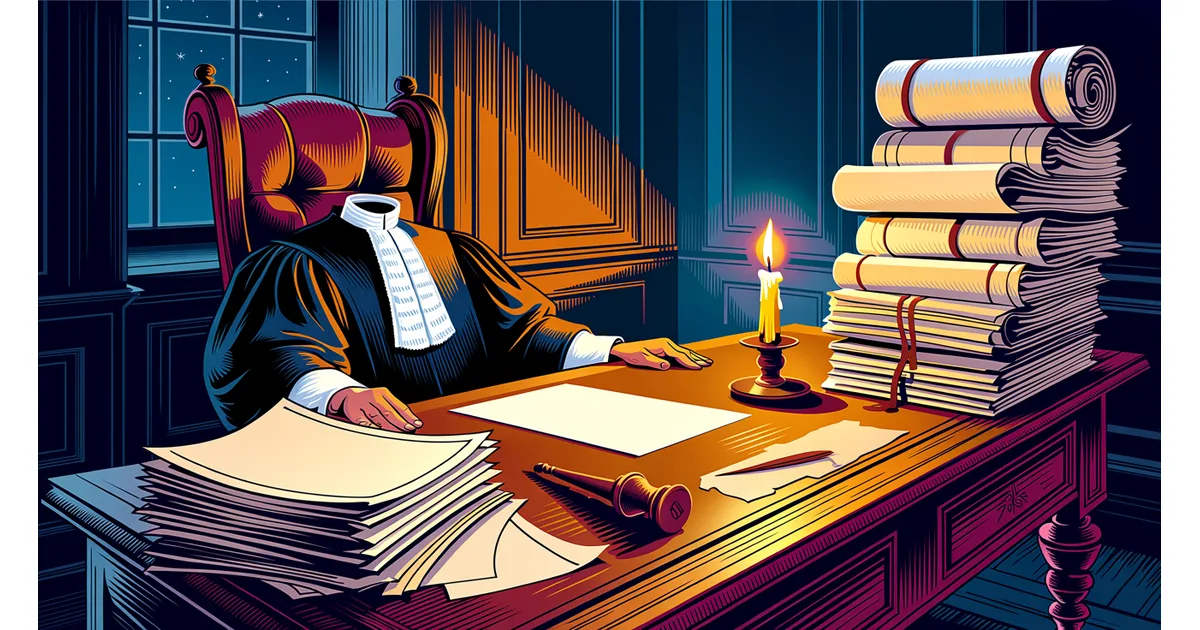
A Sitting Supreme Court Justice Went to Debtors' Prison Over Land Deals
James Wilson helped write the Constitution, then bought land on terms that demanded cash he didn't have. He was jailed for debt twice while on the bench. The carrying-cost lesson still applies.
We wrote recently about Robert Morris, the financier of the Revolution who died broke after America's first real estate crash. Here's the companion case from the same collapse, and in one specific way it's the more instructive one, because the mechanism that killed this portfolio wasn't a missing loan or a defaulting buyer.
It was carrying costs.
James Wilson was not a marginal figure gambling above his station. He signed the Declaration of Independence. At the Constitutional Convention he proposed the single-person presidency and the Electoral College, and as the Committee of Detail's draftsman he wrote the working draft the final Constitution closely followed. Mount Vernon's digital encyclopedia notes he is the only person who signed both the Declaration and the Constitution and then served on the Supreme Court, where George Washington placed him in 1789 as one of the original justices. When he gave America's first law lectures that winter, Washington, Adams, Jefferson, and Hamilton sat in the audience.
By 1798 he was dead at 55 in a colleague's house in Edenton, North Carolina, having spent his last year, in Mount Vernon's words, largely absent from the Supreme Court and fleeing from his creditors. He had been arrested and jailed for debt twice while a sitting justice. It took a presidential order, Theodore Roosevelt's in 1906, to bring his remains home to Philadelphia with the honor he'd forfeited.
Between those two paragraphs is a checklist of property mistakes that hasn't aged a day.
The instrument that sank him
Wilson's income was real: twenty years at the top of the Philadelphia bar, per the DSDI signer biography, gave him serious capital. The problem was what he bought with it. Alongside conventional holdings, Wilson purchased warrants on huge tracts of frontier land, and those warrants came with a catch that should sound familiar to every condo owner reading this: they required regular maintenance payments to stay alive.
Read that carefully. The asset wasn't just illiquid. It was an asset that billed him. Stop feeding it and it dies, taking the invested capital with it. The 18th-century land warrant with maintenance payments is the direct ancestor of every modern property whose ownership carries mandatory, non-negotiable, owner-can't-control cash demands: HOA fees that ratchet, special assessments that arrive by certified mail, metro-district mills, mandated retrofits. You don't own an asset like that so much as subscribe to it, with your equity as the cancellation fee.
When Wilson's cash flow tightened in the credit squeeze of 1796 and 1797, he couldn't make the maintenance payments. DSDI's account is dry and devastating: unable to meet these payments, he fell seriously into debt.
The behavior that finished the job
Here's the part that makes Wilson a psychology case study and not just a victim of terms. Mount Vernon's researchers put it in one sentence: he owed hundreds of thousands of dollars in land debt but continued to purchase more land despite his insolvency.
Underwater, he kept buying. Every property investor who has "averaged down" into a falling, illiquid market knows exactly what was happening in his head: the next purchase would be the one that fixed the portfolio, the market would turn before the notes came due, and selling now would mean admitting the earlier prices were fantasies. The market did eventually turn, decades later, long after it mattered to him. Illiquid assets don't reward conviction on a deadline. They reward survival, and survival is a cash-flow property, not a courage property.
The Panic of 1797 called the question, the same panic that put his friend and client Robert Morris in Prune Street debtors' prison. Wilson, a justice of the United States Supreme Court, was jailed for debt twice, in periods DSDI describes as brief, released when his son raised the money, and spent his final months riding the southern circuit at least partly to stay out of reach of process servers. He died of malaria, per Mount Vernon, in the home of fellow Justice James Iredell in August 1798: the first Supreme Court justice to die in office, and surely the only one doing so while dodging arrest.
Three rules his file writes for you
Carrying costs are senior to your plans. Wilson's warrants didn't care that he was brilliant or that the land was genuinely valuable long-term. The payments were due on the calendar, not on his timeline. Before buying any property, price the mandatory annual carry (fees, taxes, insurance, assessments, mandated work) against your worst-year income, not your best. Our worst real estate investments ranking is, at bottom, a list of asset types whose carry can spike without owner consent.
Never average down into illiquidity. Adding to a losing position is at least arguable in assets you can exit in an afternoon. In property, doubling down doubles the carry while halving your flexibility. If your response to a struggling real estate position is buying more of it, you're not investing; you're negotiating with your own earlier decision.
Status is not collateral. A Supreme Court seat did not stop the warrants from lapsing or the sheriff from coming. Neither will a strong salary, a good title, or twenty successful years. The building's reserve study doesn't know who you are. Check the HOA's red flags the way a stranger would, because the math treats you like one.
The Condo Trap exists because the Wilson instrument never went away; it just got a management company. The book's Property Investability Score is a systematic way to spot assets that bill their owners before you become the owner being billed.
Fact-check notes and sources
- Biography, land warrants requiring regular maintenance payments, falling into debt when unable to meet them, two brief imprisonments while a sitting justice, release funded by his son, death at James Iredell's home in Edenton on August 21, 1798, the 1906 Roosevelt-directed reburial in Philadelphia, Committee of Detail drafting role, Bank of North America advising for Robert Morris: DSDI, James Wilson
- "Owed hundreds of thousands of dollars in land debt but continued to purchase more land despite his insolvency," the final year largely absent from the Court fleeing creditors, death from malaria at 55, first justice to die in office, only person to sign the Declaration and Constitution and serve on the Supreme Court, the 1789 appointment, the December 1789 first law lecture attended by Washington, Adams, Jefferson, and Hamilton, single-executive and Electoral College proposals: Mount Vernon Digital Encyclopedia, "James Wilson"
- Appointment dates (nominated September 24, 1789, confirmed two days later): Supreme Court Historical Society
- Companion piece on the same panic: America's First Real Estate Crash Bankrupted the Man Who Financed the Revolution
This article is informational, not financial or investment advice. Historical institutions are referenced as nominative fair use; no affiliation is implied.