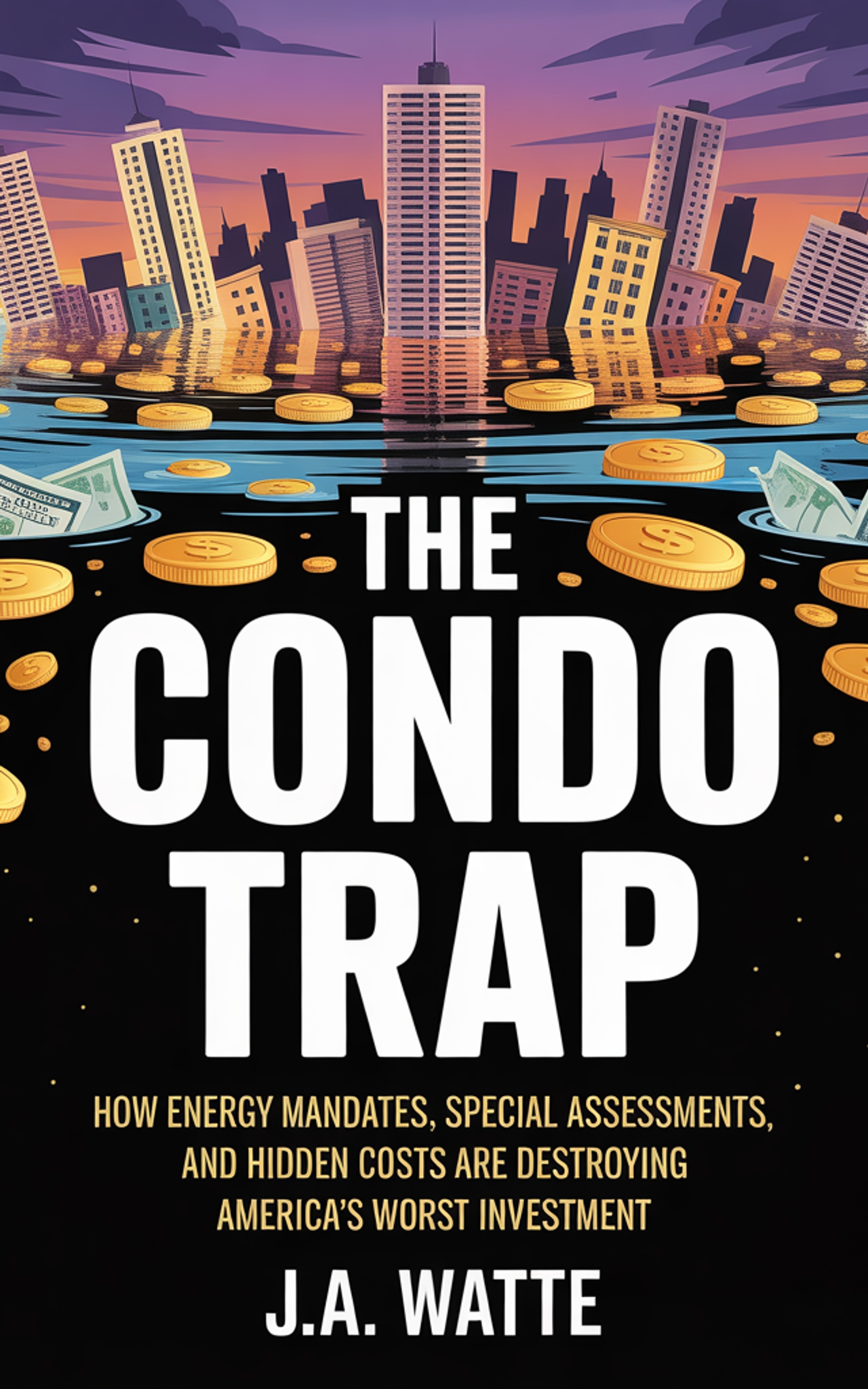
The Condo Trap
Written for first-time real-estate investors and current condo owners. Also for anyone weighing HOA-governed versus single-family ownership over the next 25 years.
Save $10K–$20K in listing commission, post-NAR settlement
The Commission Savings Calculator compares a flat-fee MLS service (Fizber, Homecoin, Beycome, Houzeo, GetRidley) against the traditional 5–6% commission. It adds a title company and an optional real estate attorney to the flat-fee side. The math is state-aware. Colorado's 0.5% closing-fee equivalent, the 22 attorney-required states, and condo resale-certificate timing are all built in.
The $1,900 Problem
A mortgage-free condo in Denver still costs $1,900 every month in carrying costs nobody told you about.
| Expense | Monthly Cost |
|---|---|
| HOA Dues | $450 |
| Property Taxes | $350 |
| Special Assessment (amortized) | $200 |
| Insurance (unit owner policy) | $150 |
| Energize Denver Compliance | $125 |
| Utilities (electric, gas, water/sewer) | $275 |
| Metro District Tax | $175 |
| Maintenance Reserve | $175 |
| Total Monthly Carrying Cost | $1,900 |
Source: The Condo Trap, Chapter 1. Based on real Denver metro data, 2024–2026.
The 7 Forces Draining Your Equity
Each one is manageable alone. Together, they are a financial trap that most owners never see coming.
Energy Mandates
The Condo Trap tracks 40+ city building performance standards. These include Energize Denver, New York's Local Law 97, Boston's BERDO, and Washington DC BEPS. Each one forces multifamily buildings to hit emissions targets or pay escalating fines. When a building falls short, condo owners split the retrofit bill (typically $15K–$60K per unit) plus the fines. The money comes through a special assessment or a line-item HOA increase.
Insurance Crisis
Post-Surfside reforms, CAT bond repricing, and climate risk have sent condo insurance premiums soaring 40–300% in a single year.
Special Assessments
Deferred maintenance meets new structural inspection mandates. Six-figure assessments are no longer rare — they are becoming routine.
Metro Districts
Colorado metro districts are taxing entities created by developers. They layer 50–80 mills on top of regular property tax to pay for infrastructure the developer chose not to fund. Over a 20-year hold, a $500K metro-district condo can pay $80K–$140K more in property tax. An identical unit one block outside the district avoids all of it. The mill levy rarely appears on the settlement sheet.
Taxes & Pensions
$5.1 trillion in unfunded state pensions. In Chicago, 80% of property taxes go to pensions. These obligations only grow.
Environmental Risk
Environmental risk touches 50% of Colorado homes through radon above the EPA action level. PFAS contamination affects thousands of US water systems. Wildfire-smoke days have tripled since 2010 across most Mountain West metros. Mitigation, filtration, and air-sealing retrofits run $2K–$25K per unit. Insurance carriers are starting to price these risks into premiums. That makes environmental exposure the hidden cost most buyers never check.
Utility Costs
Utility inflation hits condo owners twice. Electric rates are up 35% since 2020 across most US markets. Water and sewer costs have roughly doubled in the same period. In master-metered buildings, the HOA splits the whole utility bill pro-rata across units. Efficient owners end up paying for their neighbors' waste. They also cover building-side losses from aging pipes, cooling towers, and old lighting.
The Numbers Don't Lie
Then vs. Now
The same condo, twenty years apart. Same square footage. Radically different cost of ownership.
| Category | 2006 | 2026 |
|---|---|---|
| HOA Dues | $200/mo | $450/mo |
| Property Tax | $180/mo | $350/mo |
| Insurance | $40/mo | $150/mo |
| Special Assessments | Rare | $200/mo avg |
| Energy Mandate Compliance | $0 | $125/mo |
| Metro District Tax | $0 (few existed) | $175/mo |
| Utilities | $150/mo | $275/mo |
| Total | $570/mo | $1,900/mo |
233% increase in carrying costs in twenty years — with zero mortgage involved.
The Competition
See what The Condo Trap covers that no other book does.
| Topic | Rich Dad Poor Dad |
Rental Property Investing |
Condo & HOA Guides |
The Condo Trap |
|---|---|---|---|---|
| Building energy mandate penalties (12+ cities) | ✗ | ✗ | ✗ | ✓ 12 cities mapped |
| Insurance crisis + CAT bond exposé | ✗ | ✗ | ~ | ✓ follows the money |
| Special assessment math + Florida parallels | ✗ | ✗ | ~ | ✓ $10K–$400K/unit |
| Metro districts, MUDs, CDDs (national) | ✗ | ✗ | ✗ | ✓ 5 states |
| Condos + townhomes + SFH (all 3 property types) | ✗ | ~ SFH only | ~ condos only | ✓ all 3 |
| Underfunded pensions consuming property taxes | ✗ | ✗ | ✗ | ✓ $5.1T unfunded |
| Infrastructure deferred maintenance ($5T+ bill) | ✗ | ✗ | ✗ | ✓ water, sewer, grid, gas, roads |
| Inflation-adjusted cost timelines (BLS + ShadowStats) | ✗ | ✗ | ✗ | ✓ 20-year data |
| Property Investability Score framework | ✗ | ✗ | ✗ | ✓ 1–100 score |
| Value Score for rating cities (12 metros) | ✗ | ✗ | ✗ | ✓ 12 metros scored |
| Tax survival strategies (S-Corp, PTET, 1031, REPS) | ~ | ~ | ✗ | ✓ 6 strategies |
| Author lost $200K on his own condo (firsthand data) | ✗ | ✗ | ✗ | ✓ lived it |
The Condo Trap is written for buyers that existing books leave underserved. Rich Dad Poor Dad by Robert Kiyosaki teaches asset thinking without any condo-specific math. The Book on Rental Property Investing by Brandon Turner (BiggerPockets) focuses on single-family rentals. Condo & HOA Assessments by William Starr covers governance but not the seven macro cost forces. Robert Irwin's Tips and Traps Buying a Condo (2007) predates post-Surfside reforms, Energize Denver, Local Law 97, and the current insurance crisis.
Also by J.A. Watte
The Condo Trap is Book 3 in The Trap Series. The series is six data-driven books by J.A. Watte that map the full landscape of modern financial traps. The W-2 Trap diagnoses wage-dependency. The $97 Launch prescribes a digital-business exit. The $20 Dollar Agency replaces expensive marketing. The Resale Trap proves new construction beats resale over 25 years. The $100 Network scales 16 sites for $100/month. Together they cover the exits and the infrastructure across 2,611 pages.
The W-2 Trap
The $97 Launch
The $20 Dollar Agency
The Resale Trap
The $100 Network
Tools Referenced in the Book
Every claim in The Condo Trap is backed by data. These are the tools you can use yourself.
Reventure App
Housing market data and local price-to-income ratios.
AirDNA
Short-term rental analytics and market demand data.
NeighborhoodScout
Neighborhood-level crime, appreciation, and school data.
EWG Tap Water
Municipal water quality testing and contaminant reports.
Fizber
FSBO listing platform and home valuation tools.
CrimeGrade
Address-level crime risk grading across the U.S.
Common Questions
Five of the most frequent. Full list at /faq/.
Are condos a good investment?
Far less often than the real estate industry advertises. The Condo Trap runs the 25-year total-cost math on mortgage-free condos in markets like Denver, Chicago, and South Florida. It finds monthly carrying costs of $1,500–$2,400 even after the mortgage is gone. Those costs include HOA fees, special assessments, energy-mandate fines, metro-district taxes, insurance spikes, and utility pass-throughs. They compound at rates that usually outpace appreciation. The book's Property Investability Score only marks a condo as a good investment when it clears specific thresholds on those seven variables. Most urban condos don't.
What are metro district taxes and why do they matter?
Metro districts are special taxing entities layered on top of regular property tax in many Colorado suburbs. They add 50–80 mills (5–8%) to a homeowner's annual tax bill. They typically fund infrastructure the developer wanted built but didn't want to finance. The debt is bonded and paid down over 30–40 years by the people who buy the homes. Most buyers never see the mill levy line on the settlement statement. Over a 20-year hold, a $500K condo in a mid-level metro district can pay $80K–$140K more in property tax. An identical unit one block outside the district boundary avoids that entire bill. Chapter 4 walks through how to spot metro-district exposure before you sign.
What is the Property Investability Score?
The Property Investability Score (PIS) is a 7-factor framework from the book for judging any condo, co-op, or HOA-governed property. It scores the unit on HOA health (reserve study plus delinquency rate), special-assessment exposure, energy-mandate compliance cost, and metro-district tax load. It also scores insurance market stability, environmental risk (radon, PFAS, wildfire smoke), and utility-rate trajectory. Each factor is scored 0–5 based on public records and municipal data. A combined score under 22 of 35 means the property is more liability than asset. Appendix C of the book ships the worksheet and a matching calculator.
Is this book anti-condo or anti-real-estate?
Neither. The book is about the cost structures that destroy condo equity. It is not about single-family homes, rental properties, or real estate investing in general. The author owns real estate. The thesis is narrow: run the 25-year total-cost numbers with all seven hidden cost factors before you buy a condo. Most buyers don't. The book gives you the framework, the data sources, and the worked examples.
Does the book cover specific cities or is it general?
Both. The general framework applies everywhere. Deep dives with real numbers cover Denver (Energize Denver, metro districts), New York (Local Law 97), and Boston (BERDO). More chapters cover South Florida (post-Surfside inspection reforms and insurance repricing), Chicago (pension-driven property tax growth), and Los Angeles (wildfire insurance). Each city section lists the specific municipal codes, the compliance deadlines, and the cost ranges condo owners are paying. It also shows how the mandates interact with HOA reserves and special assessments. If you live in a different metro, the principles still transfer. You can pull your own municipal data using the sources in Appendix B.
Stop Paying the Hidden Tax on Ownership
The Condo Trap arms you with the data sources, the worked examples, and the 7-factor Property Investability Score framework. Use it to evaluate any condo, co-op, or HOA-governed property in America before you sign. Municipal codes across Denver, New York, Boston, South Florida, and Chicago are covered. Appendix B lists every data source. Appendix C ships the scoring worksheet. Know before you buy. Or at least know before the next special assessment arrives.