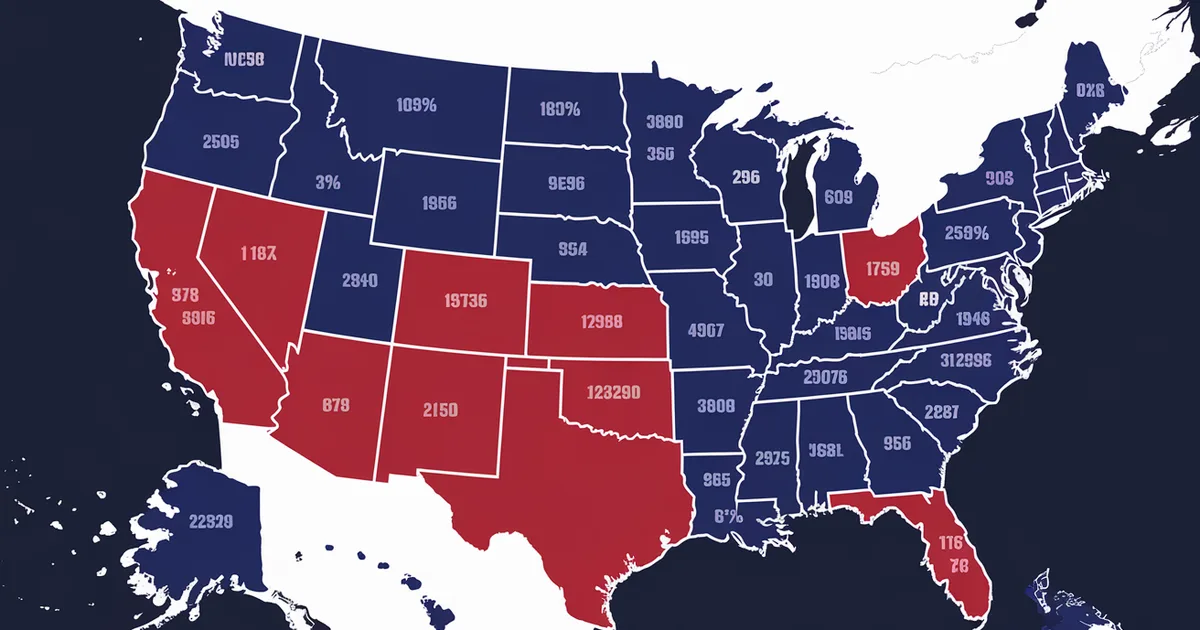
HOA Fees by State: The Complete 2026 Ranking
Average HOA fees ranked by state for 2026. See how your state compares — from $150/month in the Midwest to $800+ in coastal markets. Plus the hidden costs that aren't in the fee.
The average HOA fee in New York is over $650 per month. In Indiana, it is $155. That is a difference of more than 400% — for the same basic service: maintaining a shared building and its common areas.
Most condo buyers never compare HOA fees across states. They evaluate within a single metro, anchor to whatever the listing shows, and assume the number is roughly standard. It is not. Where you buy determines your baseline carrying cost more than almost any other single variable, and the gap between the cheapest and most expensive states has widened every year since 2020.
Here is the complete 2026 ranking — what each state actually costs, why the variation exists, and where fees are rising fastest.
The 2026 State-by-State Ranking
The figures below represent average monthly HOA fees for condo and townhome communities, compiled from association budget data, property management industry reports, and MLS records through Q1 2026. These are median estimates across each state; individual buildings will vary significantly based on age, amenity level, and location within the state.
Tier 1: $500+ Per Month (Most Expensive)
| State | Average Monthly HOA Fee |
|---|---|
| New York | $650 |
| Connecticut | $580 |
| Massachusetts | $560 |
| New Jersey | $540 |
| Hawaii | $530 |
| California | $520 |
| Florida | $490 |
| Washington, D.C. | $480 |
Tier 2: $300-$499 Per Month (Above Average)
| State | Average Monthly HOA Fee |
|---|---|
| Illinois | $460 |
| Colorado | $420 |
| Washington | $410 |
| Oregon | $395 |
| Maryland | $385 |
| Virginia | $375 |
| Nevada | $360 |
| Pennsylvania | $350 |
| New Hampshire | $340 |
| Rhode Island | $335 |
| Arizona | $330 |
| Vermont | $320 |
| Delaware | $310 |
| Minnesota | $305 |
Tier 3: $200-$299 Per Month (Near National Average)
| State | Average Monthly HOA Fee |
|---|---|
| Georgia | $295 |
| Texas | $280 |
| North Carolina | $270 |
| South Carolina | $265 |
| Utah | $260 |
| Michigan | $255 |
| Tennessee | $250 |
| Louisiana | $245 |
| Wisconsin | $240 |
| Ohio | $235 |
| New Mexico | $230 |
| Maine | $225 |
| Montana | $220 |
| Idaho | $215 |
Tier 4: Under $200 Per Month (Least Expensive)
| State | Average Monthly HOA Fee |
|---|---|
| Missouri | $195 |
| Alabama | $190 |
| Nebraska | $185 |
| Kansas | $180 |
| Kentucky | $175 |
| Oklahoma | $170 |
| Iowa | $165 |
| Arkansas | $160 |
| Indiana | $155 |
| Mississippi | $150 |
| West Virginia | $145 |
| Wyoming | $140 |
| North Dakota | $140 |
| South Dakota | $135 |
The national average in 2026 sits at approximately $310 per month — up from $250 in 2020, representing a 24% increase in six years. But that national figure obscures the massive regional variation that determines whether your HOA fee is a manageable line item or a second mortgage.
Why Fees Vary by Region
The 400%+ spread across states is not random. It is driven by five structural factors that vary geographically and compound over time.
Northeast: Insurance, Labor, and Building Age
The Northeast dominates the most expensive tier for interconnected reasons.
Building age is the primary driver. The condo stock in New York, Massachusetts, Connecticut, and New Jersey skews older than the national average — many buildings date to the 1960s through 1980s. Older buildings require more maintenance, more frequent capital replacement, and carry higher insurance risk profiles. A 1975 high-rise in Manhattan has fundamentally different maintenance needs than a 2018 mid-rise in Raleigh.
Labor costs in the Northeast are among the highest in the country. Building staff — doormen, maintenance workers, superintendents — are often unionized in New York and New Jersey, with wages, benefits, and pension obligations that flow directly into HOA budgets. A 200-unit building in Manhattan with a 24-hour doorman, two maintenance staff, and a superintendent can spend $400,000 to $700,000 per year on payroll alone.
Energy compliance mandates add a layer that did not exist a decade ago. New York City's Local Law 97 imposes carbon emission caps on buildings over 25,000 square feet, with fines beginning in 2024 and tightening through 2030. Boston's BERDO has similar requirements. Compliance work — HVAC upgrades, envelope improvements, electrification — is being funded through reserves and fee increases across the region. For a detailed breakdown of how Local Law 97 affects individual condo owners, see Local Law 97 and NYC condo costs.
Southeast and Coastal: The Insurance Crisis
Florida's average of $490 per month would have been unthinkable a decade ago, when the state averaged closer to $280. The primary driver is insurance.
Since the Surfside collapse in 2021, master policy premiums for Florida condo buildings have increased 100% to 300%. Buildings that paid $250,000 annually for coverage are now paying $600,000 to $1,000,000. On a 100-unit building, a $500,000 annual premium increase translates to $417 per unit per month — from insurance alone.
The post-Surfside structural inspection mandates (milestone inspections and structural integrity reserve studies) have further compounded costs. Buildings that discover deficiencies during inspection face both the repair costs and the insurance premium increases triggered by the findings. For more on how the insurance crisis is repricing condo ownership nationally, see condo insurance rates in 2026.
South Carolina, Georgia, and Louisiana face similar coastal insurance pressures, though not yet at Florida's severity. Hurricane exposure, flood zone reclassifications, and reinsurance market hardening are pushing premiums upward across the Gulf and Atlantic coasts.
Midwest: Low Costs, Lower Risk
The Midwest consistently produces the lowest HOA fees in the country, and the reasons are structural, not accidental.
Insurance costs are lower. Midwest states face fewer catastrophic weather risks that drive reinsurance repricing. No hurricane exposure, limited wildfire risk, and lower flood zone concentrations mean master policy premiums are a fraction of what coastal buildings pay.
Labor costs are lower. Building maintenance, management, and vendor contracts in Indianapolis, Des Moines, and Kansas City cost significantly less than equivalent services in Boston or San Francisco.
Building stock is newer and lower-density. The Midwest condo market skews toward townhomes, garden-style condos, and low-rise buildings — structures that are cheaper to maintain than high-rise towers with elevators, parking garages, and complex mechanical systems.
No energy mandates (yet). Most Midwest cities have not adopted building performance standards. That may change, but for now, the compliance cost that adds $50 to $150 per month to fees in Denver, New York, and Boston is absent from Midwest budgets.
Mountain West: The Mandate Multiplier
Colorado stands out at $420 per month — higher than any Midwest state and approaching coastal levels. The explanation is specific: Denver's Energize Denver ordinance, combined with metro district tax overlays and a rapidly appreciating market that has pushed building replacement costs upward.
Energize Denver imposes energy performance requirements on buildings over 25,000 square feet, with compliance deadlines beginning in 2024. For condo buildings, compliance costs of $15,000 to $50,000 per unit are being funded through reserve contributions, special assessments, and fee increases. For the full breakdown, see Energize Denver explained.
Utah and Idaho, while still in the moderate tier, have seen fee growth of 6-8% annually as rapid population growth drives up labor and materials costs for building maintenance.
West Coast: Scale and Regulation
California's $520 per month average reflects the convergence of high labor costs, aggressive energy mandates, earthquake insurance requirements (in some buildings), and some of the oldest condo stock in the country.
San Francisco and Los Angeles buildings frequently carry HOA fees of $700 to $1,200 per month for full-service high-rises — numbers that would be the mortgage payment itself in many Midwest markets.
Washington state's $410 average is driven primarily by Seattle, where a combination of high construction costs, energy mandates, and building age pushes fees well above the state average. Oregon follows a similar pattern with Portland as the primary cost center.
What Your HOA Fee Does Not Include
The monthly HOA fee, regardless of how high it is, covers only a portion of the true cost of condo ownership. Several significant expenses sit outside the fee entirely.
Special assessments. When reserves cannot cover a major repair, the board levies a one-time charge against all owners. Assessments of $10,000 to $200,000 per unit have become common in post-Surfside Florida and in buildings facing energy compliance deadlines. Your monthly fee tells you nothing about the probability of an assessment. Only the reserve study does. For more on this growing issue, see the special assessment crisis.
Unit-owner insurance (HO-6). Your personal condo insurance policy — covering your unit interior, personal property, and liability — is separate from the master policy funded by HOA dues. HO-6 premiums have increased 30-80% since 2020 in most markets and exceed $3,000 per year in high-risk coastal areas.
Property taxes. Assessed and paid separately from HOA fees. In states like New Jersey, Illinois, and Texas, property taxes can add $300 to $800 per month to the carrying cost of a condo — on top of the HOA fee.
Metro district taxes. In Colorado and other states with special taxing districts, an additional tax layer of $150 to $400 per month can apply to properties within district boundaries. This is not reflected in the HOA fee and is often missed by out-of-state buyers. See metro district taxes in Colorado explained.
Energy compliance costs. When they arrive as special assessments rather than gradual fee increases, they hit as lump-sum charges outside the monthly fee. A building that has not yet begun compliance planning may show a reasonable HOA fee today while sitting on a six-figure per-unit compliance obligation.
Where HOA Fees Are Growing Fastest
Not all states are rising at the same rate. Three states stand out for fee growth that significantly exceeds the national average.
Florida: 8-12% annual increases. The combination of post-Surfside insurance repricing, mandatory structural inspections, and new reserve funding requirements (SB 4-D) is producing fee increases that dwarf historical norms. Buildings that completed milestone inspections and discovered deficiencies are seeing the sharpest spikes — some exceeding 25% in a single year.
Colorado: 7-10% annual increases. Energize Denver compliance costs are now hitting budgets, layered on top of already-elevated insurance and labor cost growth. Buildings in Denver proper with BPS exposure are seeing fee trajectories that will push them into coastal-level territory by 2028.
New York: 6-9% annual increases. Local Law 97 compliance, combined with rising labor costs (driven by union contract renewals), aging building infrastructure, and insurance market hardening, is producing sustained above-average fee growth. Buildings that have not yet begun LL97 compliance work are deferring costs that will arrive as larger increases later.
Other states seeing accelerated growth include Massachusetts (BERDO compliance), Washington, D.C. (BEPS compliance — see Washington D.C. BEPS and condo costs), and California (insurance and energy mandate convergence).
Hidden Multipliers: Building Performance Standards
The most significant hidden variable in the 2026 HOA landscape is the growing network of building performance standards across major cities. These mandates add compliance costs that sit on top of every other fee driver — and they are expanding.
Cities with active BPS mandates that affect condo buildings include New York, Boston, Denver, Washington D.C., St. Louis, Reno, and over 30 others. The cost structure varies by city and building, but the pattern is consistent:
- Audit and benchmarking costs: $5,000 to $15,000 per building, recurring
- Engineering studies and compliance planning: $20,000 to $80,000 per building
- Capital improvements (HVAC, envelope, electrification): $15,000 to $50,000 per unit
- Ongoing monitoring and reporting: $3,000 to $8,000 per building annually
- Non-compliance fines: $5,000 to $268 per ton of CO2 over the cap (NYC), accumulating annually
A state with a low average HOA fee today but BPS mandates taking effect in its major cities — such as Colorado or Massachusetts — may look very different in three years. The fee ranking above is a current snapshot. The trajectory requires understanding which regulatory costs are already in the budget and which are still approaching.
What This Means for Buyers and Investors
The state-by-state variation in HOA fees is not just trivia. It has direct implications for purchase decisions, investment returns, and long-term affordability.
For buyers: A $350,000 condo in a state with $150/month HOA fees has a fundamentally different carrying cost from a $350,000 condo in a state with $550/month fees. Over a 10-year holding period, that $400/month difference is $48,000 — money that does not build equity, is not tax-deductible (for most owners), and will be higher in year 10 than in year 1.
For investors: Cash flow projections that use the current HOA fee as a flat line item will be wrong. In states with 8-12% annual fee growth, a $400/month fee becomes $860/month in 10 years. That trajectory must be modeled against rent growth to determine whether the investment actually cash flows over the hold period. In most high-fee-growth states, it does not.
For anyone comparing condos to alternatives: The HOA fee is a permanent, escalating cost with no equity return. It exists in no other property type at this scale. A single-family home has maintenance costs, but the owner controls the timing, vendor selection, and scope. The HOA fee is a cost imposed by collective governance with no individual opt-out.
This is why The Condo Trap introduces the Property Investability Score — a seven-dimension framework that accounts for fee trajectory, insurance exposure, tax structure, energy mandates, and reserve health before you commit to a purchase. The monthly fee on the listing sheet is the least useful data point in the analysis. The trajectory behind it is what matters.
The Condo Trap provides the full cost model — the Property Investability Score — for evaluating any condo in any state against all seven hidden cost dimensions. Get The Condo Trap on Amazon.
If the math points you toward single-family instead, the next question is resale vs. new construction. The Resale Trap models the 25-year total cost comparison across all 50 states — and the gap is larger than most buyers expect. And if you are looking to build income streams that do not depend on property ownership at all, The $97 Launch covers 30+ digital businesses you can start for under $97.